

Pollen from the Nectary
Does the Middle Have an Angel?
I extend my gratitude to James Baker, friend and funder of the Nectary, and founder of Intentional Society and Intentional Ventures. Without the generous support that James offered, the conditions for my own leap into the Nectary—an opportunity I have treasured—would not have been possible. I have also been appreciating James’s recent writings, expressing a rare balance between mind and heart blended with a pragmatically grounded temperament that feels beautifully suited to the metamorphic times in which we find ourselves…
Thank you, James.
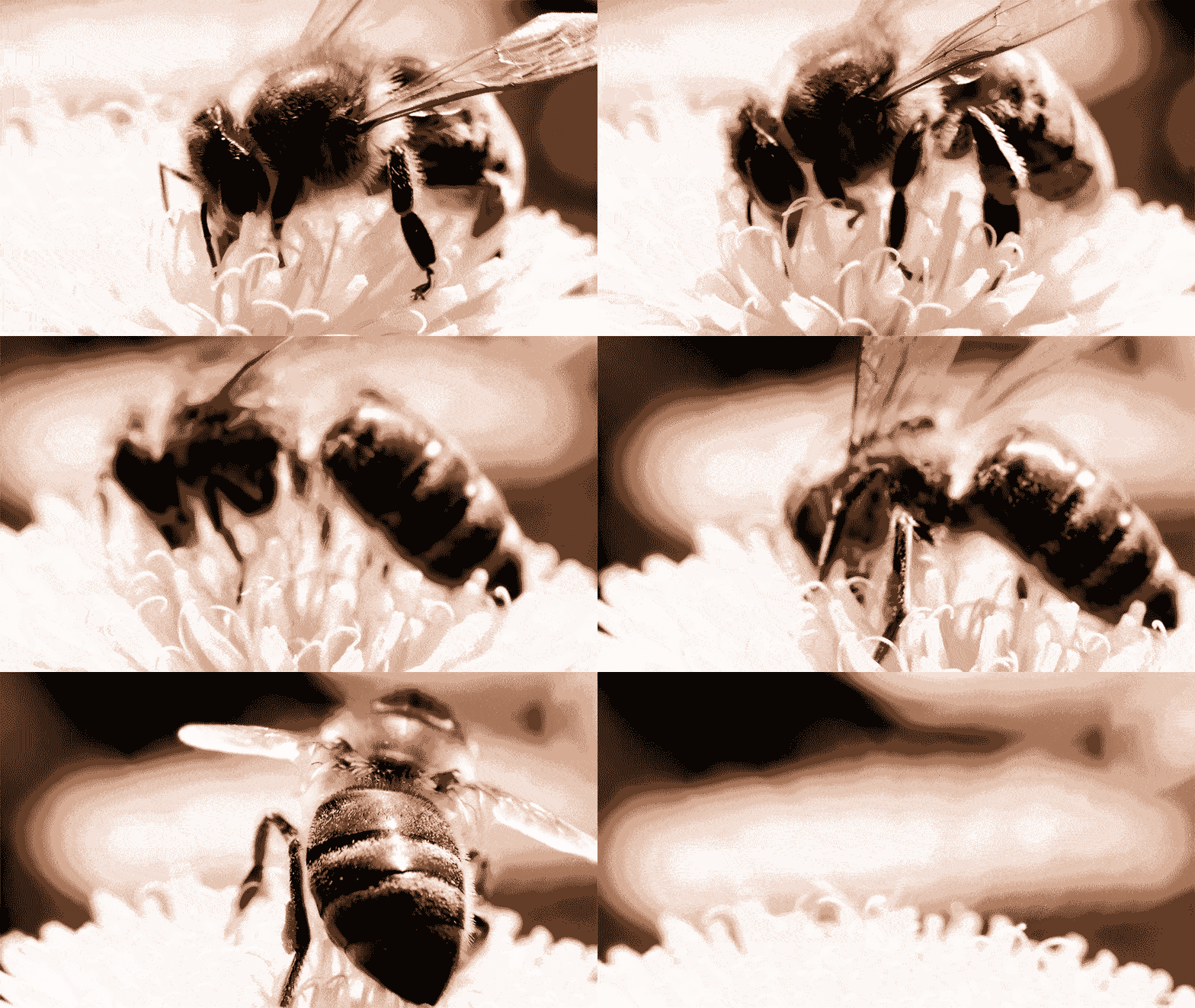
“We are the bees of the invisible.”
—Rilke
Vow Field: The Peal and The Weave
I recently learned the term peal from my mentor Meredith Sabini, as she aided me in tending two significant, and deeply interwoven, dreams.
In one scene from the first dream, I am playing a song on guitar: “Hessian Peel” by Opeth. Meredith, ever attuned to dreaming consciousness as a relentless punster whose vocabulary regularly outstrips that of the waking mind, retrieved her dictionary with an enigmatic smile.
peal, n.
a call or summons (e.g. to prayers, to church) made by ringing a bell; a stroke on a bell, or the ringing of a bell, as a call or summons.
any loud or prolonged ringing of a bell or set of bells.
a set of bells tuned to one another.
Meredith’s phonetically lateral intuition appeared to be symbolically vindicated by a scene from the second dream. I am living closely with a number of friends. We are listening to music, cooking something up together. All the while, someone is ringing the doorbell. The dream ends with me thinking that maybe I should be the one to hearken to the bell’s summons and go answer the door.
Both dreams contained much more, and tending them with Meredith drew out a far richer tapestry of resonances than can be conveyed here. What I will share is that, through the process, I came into greater clarity concerning some significant choices that will likely mean leaping further into committed contemplative and collaborative constellations with intimate friends who seem to vibrate with a similar tone. This clarity ripened into the decision to take the leap and say yes to latent possibilities presently beckoning me.
Living in alignment with soul always entails encountering peals. A choice field opens up, and the soul makes its appeal through the wordless signals of deep allurement.
I believe that a crucial element of the present consciousness mutation—amidst which we are all witnesses, subjects, and participants—entails a fundamental transformation in the experiential dynamics of ensoulment. As part of this transformation, individuals will increasingly sense their personal vows as situated in a vow field, a subtle nexus of souls-in-resonance.
As we cultivate our capacity to hear and feel the call notes issuing from the subtlest of bells,1 we will find ourselves naturally drawn toward an emerging cultural ethos rooted in reciprocal support and mutual investiture into our collective unfoldment. We begin discovering that the directionality of our personal stories interweave—organically, uncannily—through a relational tapestry of creative interbeing.
Ensoulment is entangled. Individuation is always interviduation. The soul’s poiesis, necessarily lured into sympoiesis.
Prelude: Dechen’s Appeal
peal, n.
† Senses relating to appeal n. (in various senses). Obsolete.
a. an application (as to a recognized authority) for corroboration, vindication, or decision
b. an earnest plea : entreaty; an appeal for help
c. an organized request for donations
the power of arousing a sympathetic response : attraction
In the brief time I’ve known my friend Dechen—just over a year now—I’ve been invited, more than once, into collaborations requiring that I stretch beyond my usual capacity and pick up a slightly “heavier load” than I am comfortable with, each time to my initial ambivalence and eventual gratitude.
One thing I have found particularly beautiful is the way that I consistently feel Dechen’s invitations as fully open handed—no pressure, no pushiness, no demand. The “vibe” feels free from any flavor of subtle manipulation or coercion.
It feels, rather, like being met with a simple gesture from someone honoring the allurement their own soul’s calling by expressing the desire that I join them as an accomplice. The appeal is held out upon an open hand, a lighthearted smile conveying recognition and acceptance that the choice is mine.
When receiving Dechen’s invitations, I have done my best to listen deeply and attune to what feels true and aligned on a soul level. So far, I have repeatedly discovered a clear “yes.”
What does this yes feel like?
It feels like being met with an invitation coming not merely from the person across from me, but also from somewhere deeper: as if life itself, soul itself, were calling me forth. It feels like receiving a generous current of free energy whenever I tune to the possibility of saying “yes,” marked by a sense of intrinsic motivation that is somehow both mine and not mine. It feels like my soul would suffer if I were to refuse on the basis of fear or self-doubt. It feels like taking my natural place in the world by turning my energies toward that which I innately long to serve.
I find my connection with Dechen already entangled amongst a slowly growing tapestry of aligned individuals, some of them teachers, many of them intimate friends or collaborators. A certain number of these friends have sounded occasional peals impelling me to leap forward into new territory in full affirmation of the discomfort that growth demands.2
Dechen recently made an appeal that I am deeply grateful to have followed just beyond my comfort zone into fresh growing pains. It led me through a week at the Nectary, a recent project that she stewarded in the role of Sourcekeeper.
What is the Nectary 🐝❔
I find it difficult—if not impossible—to yield a simple, singular definition that would satisfy my perception of what the Nectary is. Here is the overarching description from the Nectary website’s “theory page”:
“The Nectary is a monthlong research and teaching gathering aimed at restoring our human capacity for intimacy, cooperation, and interdependence with the broader web of Life.”
Elsewhere, Dechen has framed the Nectary as a “pop-up relational monastery.”
It is also valuable, I think, to consider how the Nectary’s namesake symbolizes core features of its wider aspiration as an experimental container for teaching, practice, and research for generating cultural seed forms.
A nectary is a specialized gland in plants whose primary function is to produce and secrete nectar—a sugary liquid. Nectar serves two main purposes:
Attracting Pollinators
By offering a sweet energy source, plants entice insects (like bees, butterflies, moths), birds (like hummingbirds), or even bats to visit their flowers. While collecting nectar, these animals inadvertently pick up and transfer pollen, enabling cross-pollination.Mutualistic Relationships
Beyond flowers, some plants have extrafloral nectaries (found on leaves, stems, or petioles). These don’t serve pollination directly but attract ants and other protective insects. In exchange for nectar, these insects defend the plant against herbivores.
The Nectary is composed of a core group of eight individuals, many of whom hosted workshops and events offered to local contacts in Victoria, B.C. Some time after the core group began convening, a number of guest hosts and teachers were additionally invited into the field, including Sabra Saperstein, Samantha Power, and myself.
Dechen, as source, sounded the initial peal that attracted the core group to assist her in stewarding the field of the Nectary. She also extended the subsequent invitations attracting internal guests, some of whom generated offerings that also attracted visitors from the wider community. The vision of a “cross pollinating” interplay between theory, practice, and research ideally unfolds not just between the core group and guest hosts, but ultimately through the wider field of “mutualistic relationships” extending through and beyond the visiting guests attracted by the Nectary’s appeals to participate in various domains of learning and practice.
In this light, I might frame the Nectary as an experimental gesture aiming to generate cultural seed forms for postconventional patterns of living, relating, practicing, cooperating, and coordinating that may gesture toward latent regenerative futures.
Inhabiting latent “futures” is really a matter of radical presence, where what-is-to-come is inseparable from the field of properly aligned choices and possibilities available to us right now. The Nectary, as I experience it, attempts to generate a field where the resonance of those potentials can be more readily heard and responded to.
I might also describe the Nectary as having a “metamodern” sensibility, insofar as its theoretical underpinnings express a concern with the “metacrisis” as an existential horizon contextualizing what it presently means to be a human being. Metamodernism seeks pathways toward right relationship with the earth process amid this phase in its evolutionary unfolding.
It also broadly adopts a deliberate posture toward human development and ensoulment as crucial elements in the aspiration to steer the decomposing superstructures of late modernity toward regenerative cultures and systems better suited to supporting the flourishing of life on earth. These ideals call upon us to develop our capacities for moral courage, creative participation, affirmation of responsibility, and deepening relational integrity as members of the earth community.
The Nectary, in this light, could be viewed as a practice field for becoming metamorphosis, seeing ourselves as core constituents of the unfolding metacrisis as it transforms itself from the “inside out,” beginning with attending to the most intimate ways that we co-enact it through deeply ingrained patterns of consciousness and culture expressed through our habitual conduct.3 It does not include every facet required for this transformation, but I believe it does carry deeply valuable pieces of a much larger puzzle.
A Procession of Pollinators 🐝🐝🐝🐝🐝🐝🐝
There is a unique shape to the way that Dechen, when leaping into the role of Sourcekeeper, holds open a space for various experiments rooted in a reciprocally transforming flow between theory and praxis. You can read more from Dechen herself in her own series of dispatch articles.
Here is a list of offerings that grew out of the Nectary:
Cheryl Hsu enlisted other members of the Nectary to co-design and co-host a workshop focused on what she calls Oracular Bodies, a topic she has briefly written about here.
Four members of the core team (Dechen, Tara Dougans, Ty Stuart, and Garrett Jones) who collectively call themselves “Lyric,” led a workshop on Lyric Attunement. (“Lyric” is, in this case, derived from the philosophy of Jan Zwicky. Bonnitta Roy, drawing from the same philosophical stream, envisions what she calls Lyric Culture.)
Garrett Jones hosted a space for meta-paradigmatic reflections on the relational practice of circling.
Xavier Snelgrove led a workshop on Pattern Foraging as a pathway toward encountering nondual abstraction. This inquiry might be framed as an outgrowth from Xavier’s Orbital Studies Magazine, aiming to support deeper attunement and intimacy with the world through collaborative inquiry between artists and scientists.
Abigail Lynam and Geoff Fitch of Pacific Integral led a workshop focused on moving from the deeper ground of awakened wholeness, a crucial capacity at the foundations of “causal leadership.” This sensibility partially informs their Generating Transformative Change program (see Tucker Walsh’s beautiful short film on GTC).
The final celebration included a tour of the Nectary’s experiments in “economying,” primarily sourced by Tyler Wakefield. These explorations in “sacred economy,” significantly inspired by Miki Kashtan and work on the maternal gift economy, invited others into senseful inquiry concerning how we might become more “mycelial” in our collective delegation of resources. This entails breaking taboos surrounding explicit communication about the often unseen distribution of resources and needs, willingness and capacity that subsist within any social field. This very much includes, and even centers, money. Choosing to lean into these sorts of processes together, we open the door for asks and offers to be made, for the siloing and hoarding of resources to be softened, for gifts to be extended in the spirit of care, and for the boundaries of “self” to be rendered fluid. (Jame’s Baker’s recent writing on “the interbeing economy” is deeply resonant here).
I also hosted an offering at the Nectary, in close keeping with the spirit of my own unfolding inquiry lured ever-onward by the "hidden whisper” who has guided the Reverician project from its outset…
Does the Middle Have an Angel?
“Tending the Central Fire” was an experiment in Communal Reverie hosted at the Nectary, comprised of 10 participants.
I began the workshop by reading a passage that Tara had posted in the Nectary’s discord channel. I was quite pleased by this, as it is easily my favorite passage from Tom Cheetham’s book Imaginal Love:
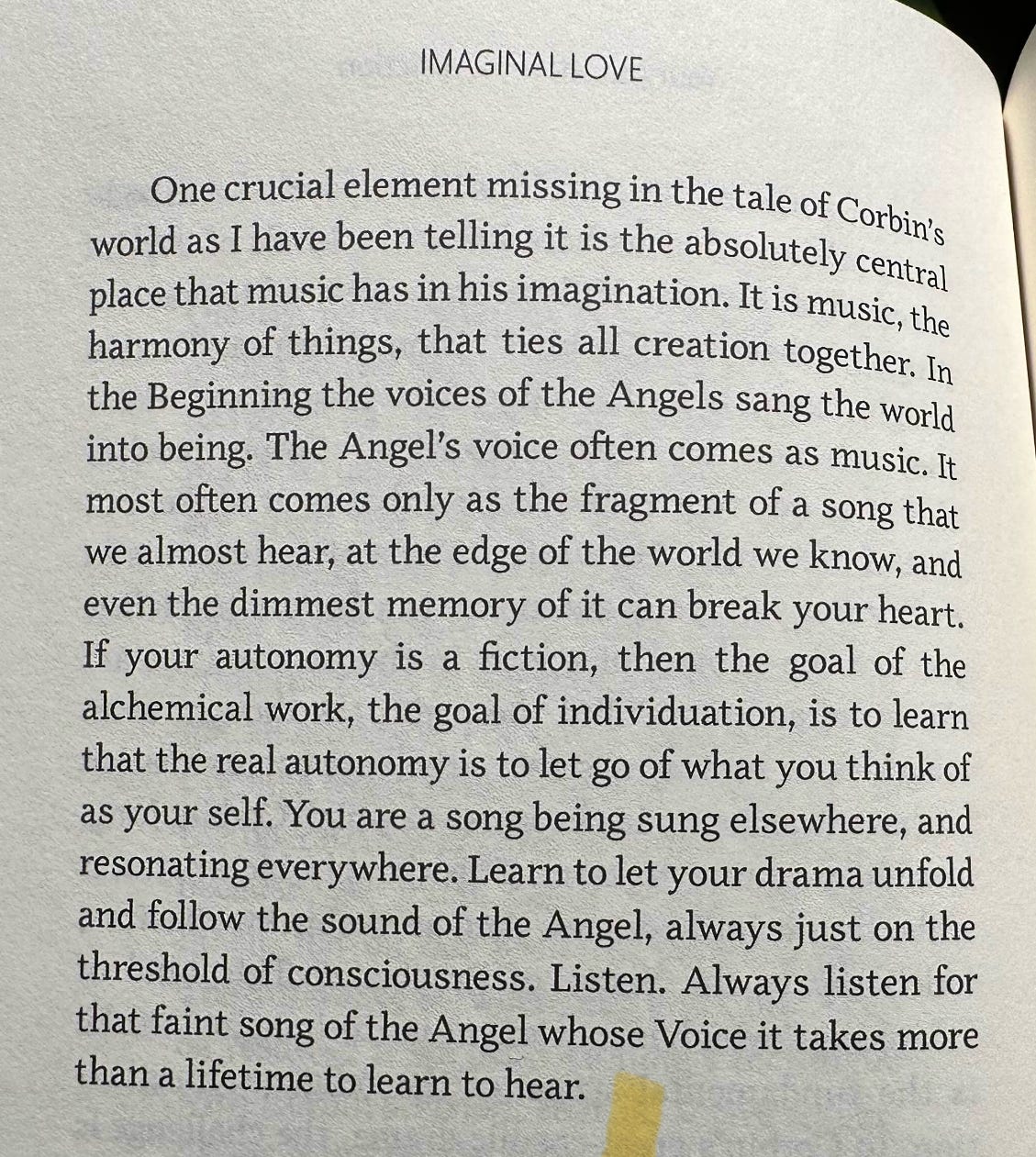
The Angel can be imagined as a very subtle resonance that beckons from the soul. In other words, the Angel is a peal. It expresses the dynamic whereby the archetypal roots of your singular personality, beyond time, enters into history as an erotically calibrated calling that lures from the future, beckoning you to live into your most authentic latent potentials.
The fundamental inquiry guiding my sourcing of Communal Reverie concerns the question of whether the role played by the Angel in the impulse toward individuation finds its emerging equivalent, likewise expressed through the imaginal background, as a dynamic factor involved in the growing emphasis on transindividuation that we would expect to see as an indicator of a Second Axial Age.
As I pondered this during a walk through a nearby Victoria neighborhood on the morning of the workshop, a guiding question came into focus for a Collective Presencing style check-in as a way to tend the field:
In your life now, where is your most onward-leading longing luring you?
Upon making it back to the house where the workshop would be staged, I was given pause by what felt like a wink from the angels. A bag, on which the words “Patient Belongings” was printed, sat before the front window, partially obscured to deliver a curiously resonant message:

After the the opening check-ins, informed by the shaping influence of the guiding question, I invited everyone to write or draw something on a notecard that symbolizes the sound of the deepest peal they can currently detect in their lives—that faint angelic music that Cheetham so beautifully describes. The cards were then offered to the middle of the field in preparation for the Communal Reverie session.
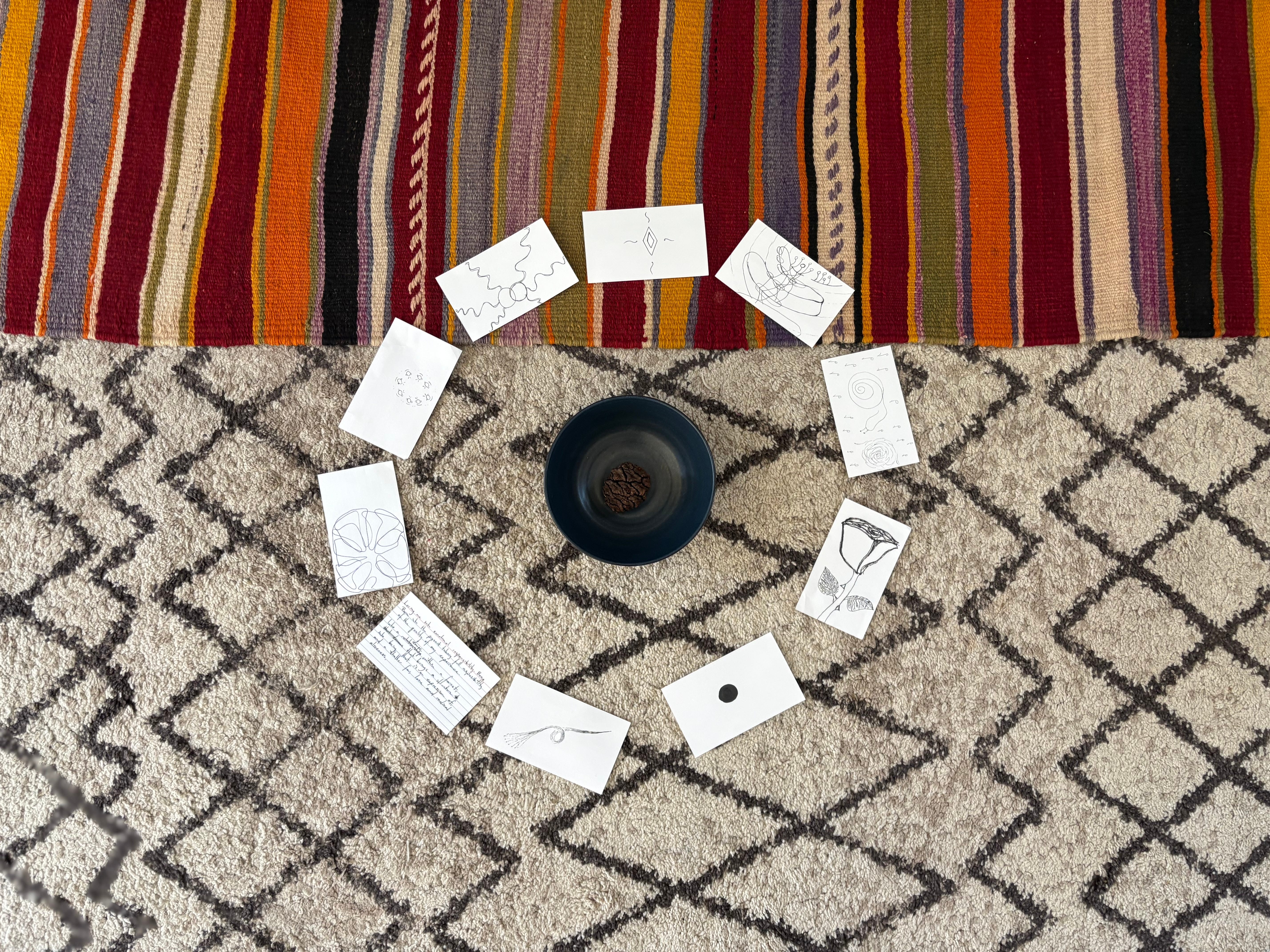
I won’t report here on the details of what came through when the 10 bodies engaged the practice of collective imaginal attunement during the session.
What I will share is the research question that came into focus the following morning. It encapsulates the central theme underlying my own thread of inquiry, which I added to the Nectary’s tapestry of theory and practice by posting it on the Nectary’s research wall, surrounded by a cloud of nerdspeak.
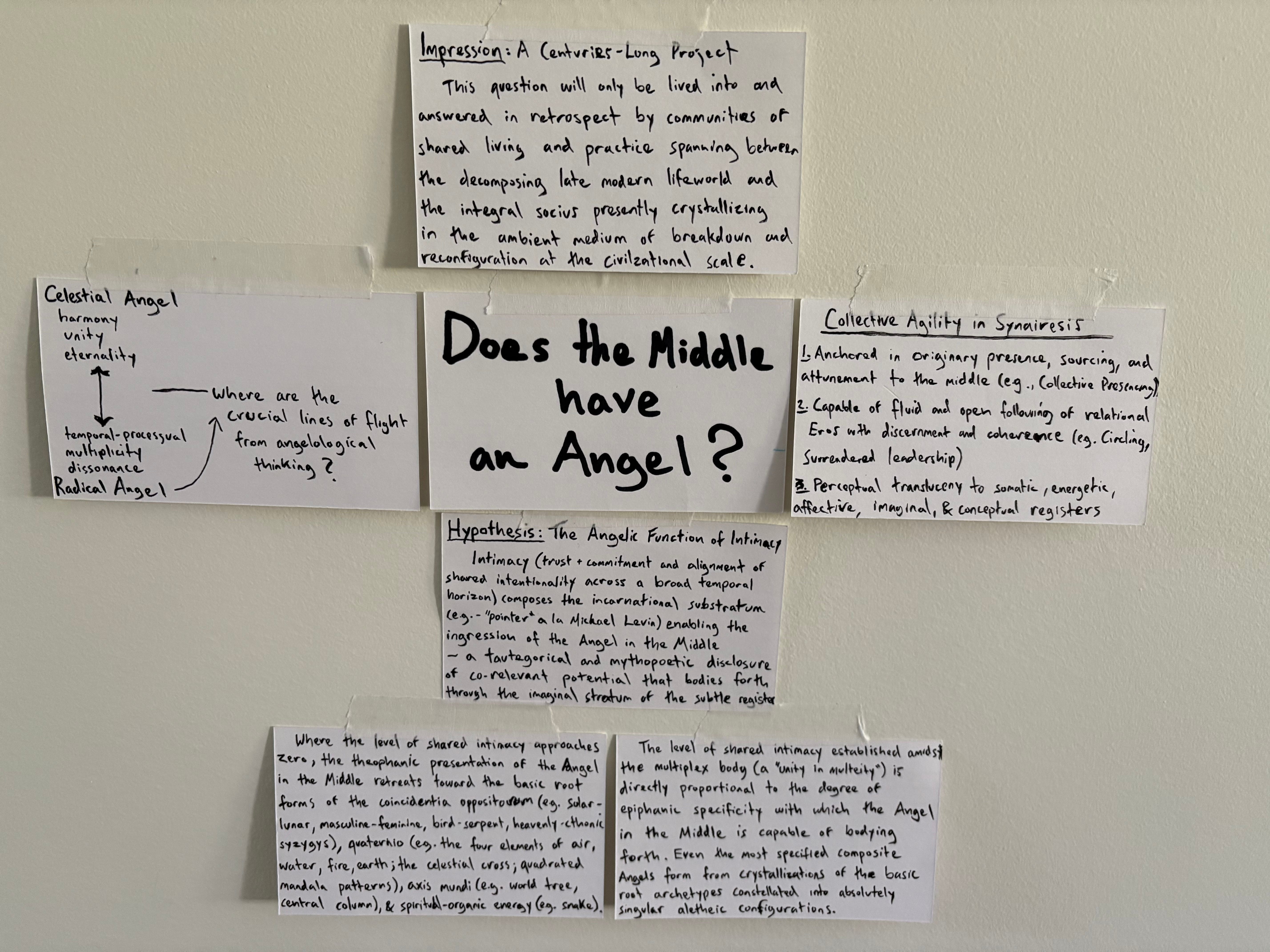
I will let that lie as it stands, refraining (for now4) from unpacking the condensed language I opted to use for the sake of conveying my thoughts to adequate completion within the spatial constraint of a few notecards. For more context concerning the core question, I’ve written elsewhere on what is meant here by “the middle.”
Angel, Descend!
Much of the Nectary’s research through the month of August involved what could be construed as “subtle” phenomena—whether we think of “subtle” in terms of the intangible yet materially consequential dimension of the noospshere known as the “social imaginary,” or alternatively consider the “subtle realm” of more mystically-flavored visionary signals encountered and honored by “oracular bodies.” I find myself imaging that the pollen produced and gathered at the Nectary is now primarily being dispersed at that subtle level, hopefully to bear eventual fruit far and wide, exfoliating into the concrete world with right timing.5
I’ve found beauty in the gentle tending of a fantasy: each of the Nectary’s participants akin to what Rilke famously described as “bees of the invisible.”6
The moment that I invoke the invisible, I immediately feel what I already know to be the final facet of the lure that has pulled me to write this article. I also sense in advance that, by honoring it, I will once again find the familiar satisfaction and quiescence that settles in after following a creative impulse through to completion…. that is, until the next doorbell rings and disturbs the peace.
This final facet of the lure resonates with the call back down to earth.
Some context: I was recently talking with Dechen about my relationship to Communal Reverie and the way it seems to express a central part of my vow. I reflected on the nagging persistence of doubt that regularly haunts me while the call note goes on ringing, forcing me to confront what I feel to be an annoying dispositional imbalance running through my relationship with vision and creativity.
I find something of this imbalance helpfully elucidated in Rudolf Steiner’s description of the Luciferic and Ahrimanic tendencies endemic to the soul, which must be brought into harmony through the balancing function symbolized in Christ. (My friend, Matt Segall, recently gave a presentation on this topic at a CIIS conference on focused on Jung.)
Stated in simplistic terms: the Luciferic tendency trends toward the spiritual, the imaginative, the visionary, the creative. The Ahrimanic, toward the material, the rational, the pragmatic, the technological.
Too much Luciferic leaning and you end up with what John Vervaeke critiques as “decadent Romanticism,” becoming transfixed and enamored with wishful or egoistic fantasies that fly up and away from concrete reality, fleeing from effective contact with the ordering constraints that govern the tangible world.
Too much Ahrimanic emphasis, by contrast, leads to deadened rationalism, sterile literal mindedness, the construction and implementation of machines (be they physical tools or bureaucratic systems) that endlessly repeat the same operations, resisting all movement toward novel and evolving pathways that would permit the ingression of more beautiful forms into existence. By stifling all creative advancement, Ahrimanic one-sidedness is no less alienated from genuine participation with reality than its Luciferic counterpart.
My disposition has, historically, expressed a chronically Luciferic bent. My earliest childhood dreams often involved flights, by various fanciful means, up into the sky. At an early age, imagination became a refuge. Dissociation, a habit. Even today, the ideal tempts me to obscure of the real, and medicinal doses of disillusionment in service of grounded sobriety run counter to my characterological preferences.
I’ll spare the case history and psychodynamic formulations that may partially illuminate this tendency. What I’m concerned with here is how this is relevant, along multiple lines, in relation to the unfolding of Communal Reverie—partially as the focus of philosophical inquiry, but more so as a practice.
True to form, the inspired logos of theoretical speculation on Communal Reverie has tended to precede the movements into practice and research. Fortunately, never by too much. Inspiration has been closely followed by experimentation, and with each concrete step I have continued to find enough of a “there” there to carry on walking.
In defense of the Luciferic: living from primordial trust often includes moments of “lightning-like inspiration”7 that impel a leap into the abyss. It is a beautiful experience when these leaps meet with unexpected ground, as if they were prompted by some inexplicable faculty that knows ahead of time.
Along these lines, there is good reason that Corbin described the Angel as “out ahead.” Insofar as they inhabit the imaginal realm, we may initially be inclined to describe Angels as inherently Luciferic beings.
Yet, the very function of Angels is to serve as a bridge between the tangible and the intelligible, the possible and the actual, by luring concrete beings to enact the realization of latent potentials. The visionary pole of their Luciferic aspect, yearningly reaching out for contact with the tangible, inspires Ahriman’s reciprocal longing to remold what is tangible to reflect the vision. Angels achieve greater concreteness by means of their capacity to inspire our imagination, seducing us to convert inspired vision into concrete reality through our creatively pragmatic response.
Ahriman’s association with technology is important here. “Technology” is derived from the ancient Greek techne (τέχνη), meaning the practical knowledge informing any art, skill, or craft. Techne forms the root of “technique.” Technique, as a skillfulness of craft, is a creative means of encountering and responding to the world’s hard constraints. Technique can only be realized through a close couplement between creative imagination and concrete reality.
Our capacity to serve the incarnation of the Angels requires that we give due patronage to Ahriman.
Next Groundward Steps
Something about my time at the Nectary has had the effect of sparking a calling to further balance, an impulse to plant my feet more firmly on the ground. I feel a deepening call to generate more theoretical propositions that patiently follow from direct encounters with the territory as a counterbalance to Luciferic speculative anticipations.
I feel that this impulse was influenced, to a significant extent, from the flavor of my encounter with the folks in the Lyric group. As I understand it, Lyric philosophy and culture has to do with paying close attention to the specific shapes of things. It involves savoring the particular resonances detected through intimate encounter between embodied beings and listening carefully to the vibe of the music that arises in relational space, the spaces in-between.
The resonant shapes emitted by the Lyric group reached out and met me like a groundward peal, calling me back to earth, leading down.
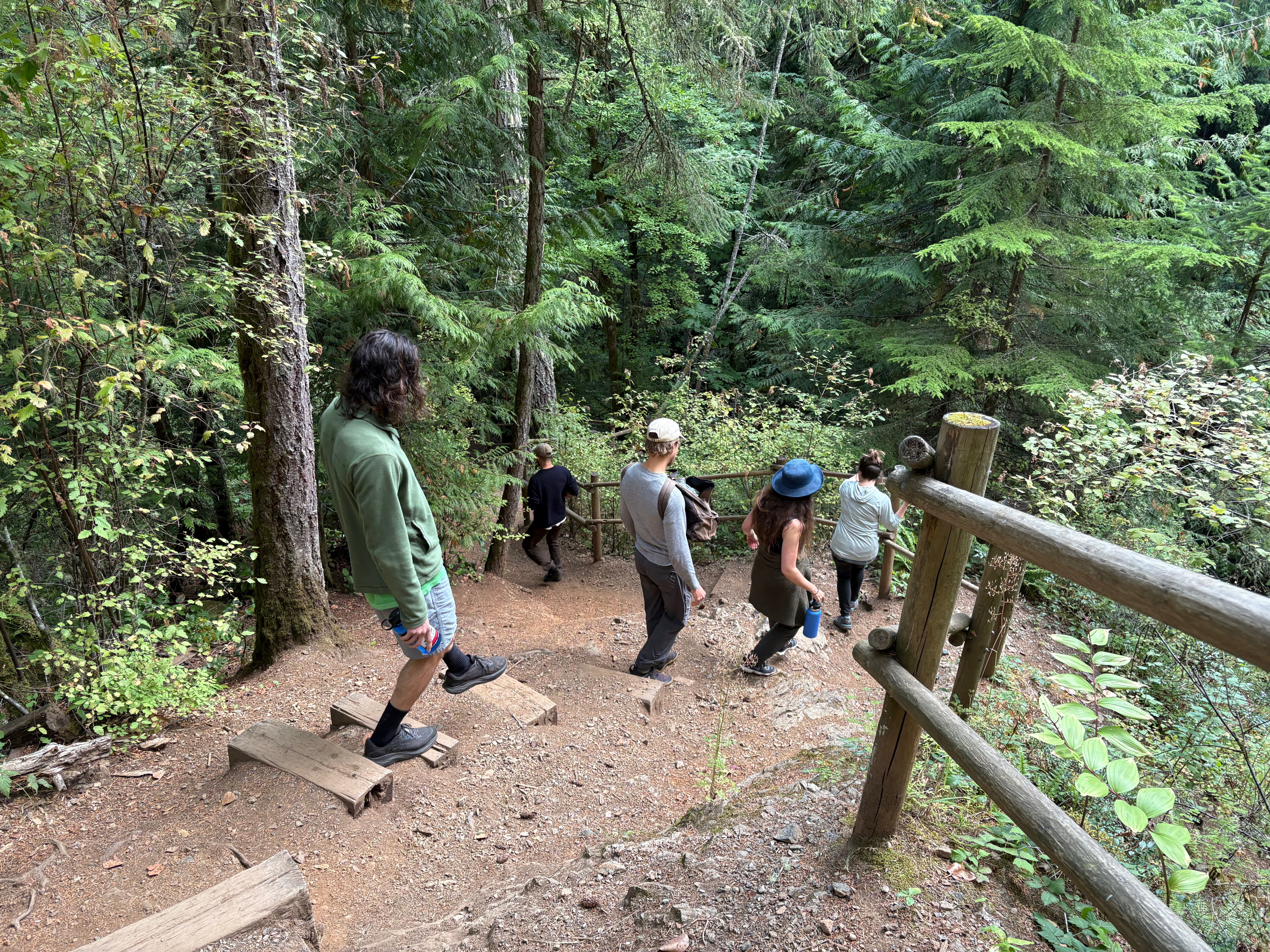
If Communal Reverie is to grow into a mature “collective wisdom technology” (as a friend once framed it), then—in alignment with my recent prospectus—I sense it is time to add a bit more Ahrimanic emphasis in my Sourcekeeping approach, deepening into research through practical inquiry and ongoing refinement in the zone where imagination flows together with technique.
Somewhat paradoxically, paying greater homage to Ahriman may support Communal Reverie’s function of introducing a necessary Luciferic balance to our heavily Ahrimanic-leaning culture.
This will be no short term project.
That said, these are multiple lines of groundward steps that are already beginning to crystallize. I anticipate that a fair amount of this will take place away from public view.
There is, however, one publicly facing step taking shape. A field for practice rings the doorbell. For that, stay tuned….
When it comes to Rilke, I am happily fated to be a broken record:
“Be—and know as well the terms of nonbeing, the infinite ground of your inmost vibration, so that, this once, you may wholly fulfill them.”
Sonnets to Orpheus (Bk. 2, Sonnet 13, Edward Snow trans.)
It may be that by simply aligning with the vectors through which our clarifying desire leads us, we will find ourselves lovingly catalyzing growing pains in those that we love insofar as our callings come innately enfolded with appeals for collaboration that will necessitate further growth and development for all involved.
Soulful friendships may ask that we embody, for each other, the ideal that Goethe famously advances in his novel Wilhelm Meister’s Apprenticeship:
“If you treat a person as they are, they will remain how they are. But if you treat them as if they were what they ought to be and could be, they will become what they ought to be and could be.”
As Bonnitta Roy often refrains, “the malware runs deep.”
I expect that I will unpack more of what is implicit on those cards in future writings, including in a long-gestating piece about an “angelology of organism.”
My doctoral dissertation included some discussion of Gurdjieff’s notion of “reciprocal feeding,” which Cynthia Bougeualt adopted in her book Eye of the Heart to speculate on the vital interchange between subtle and material planes of existence. It is primarily in experiences of imaginal causality (a term Bourgeault coined) that we may most readily intimate some kind of interplay between archetypal forces and the mundane events of life.
A brief passage of the 1925 letter from which the passage is taken can be read here. I would strongly recommend, to those who feel even the slightest lure, to track down the astonishing and bottomless letter and read it in its entirety (hint: it is possible that I can be appealed to for this). To my mind, it warrants as many readings as do any of his poems.
“In the winter of 1931/1932, [Gebser] found himself in the ancient Phoenician city of Malaga, in southern Spain, where he had what he later described as a ‘lightning-like inspiration’ for the work he would spend the next twenty years elaborating and articulating.”
https://www.aaroncheak.com/from-poetry-to-kulturphilosophie